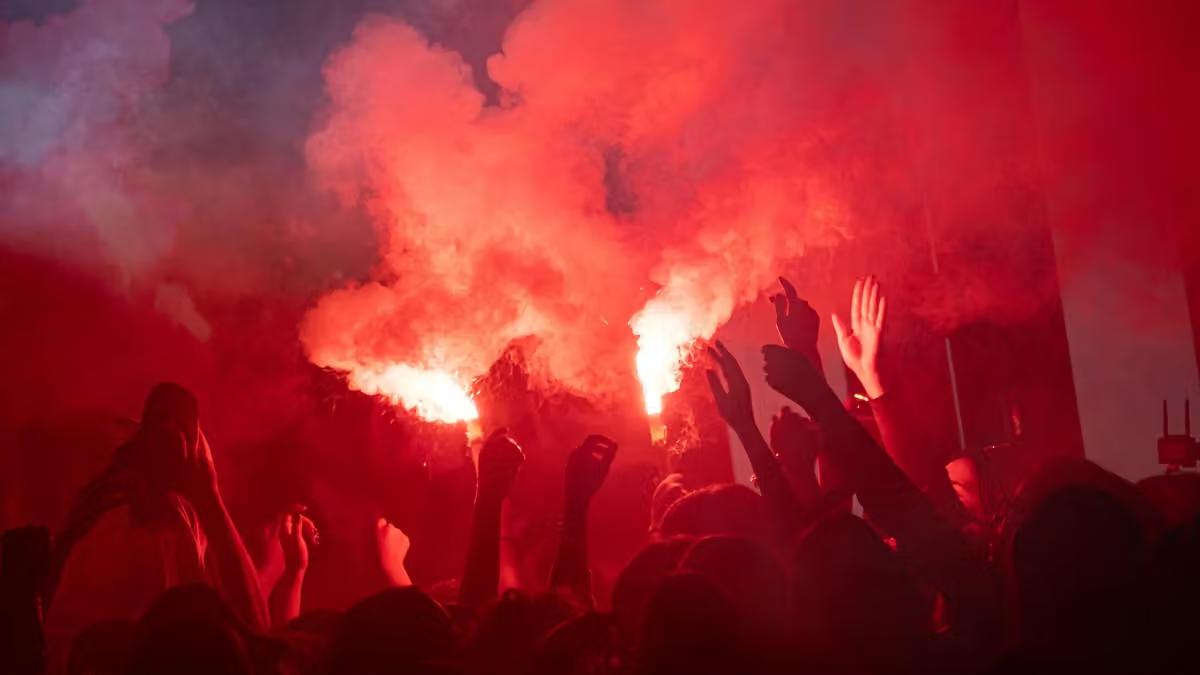
A 19th-century town hall in Limoges went up in flames during protests in France. The fire destroyed part of the building and took down its spire. France has seen many protests. It has not often seen public buildings treated this way.
That is the part worth pausing on. Hundreds of thousands of people marched against the cost of living and poor conditions in schools. Most marched peacefully. Yet in several cities, cars burned, shops were looted, and municipal buildings were damaged. The gap between a mass demonstration and a night of destruction is where the real story sits.
Why does this feel different?
France is used to protests. Strikes, marches, blockades, and loud arguments with the state are familiar parts of public life. The country has institutions and habits for them.
But the images from this weekend do not fit the usual pattern. In Lyon, the city’s tourist office was set on fire. In Marseille, people forced their way into City Hall, left graffiti, and knocked over a bust of Marianne, a symbol of the French Republic. In Paris, the Arc de Triomphe was vandalized. In Limoges, the town hall was set ablaze.
These are not random objects. They are civic buildings, historic places, and symbols people use to locate themselves in a shared public world. When they become targets, the message is not only about policy. It is about whether the rules of protest still hold.
I do not know who benefits from that message. That is the question. A government facing unrest can use images of burning buildings to justify tougher policing. Protest organizers can say violent groups do not represent their cause. Businesses, insurers, tourists, and local residents all have reasons to watch closely. None of those interests proves anything about intent. But each has a stake in how the story is framed.
What is documented
The demonstrations began as protests over rising living costs and conditions in schools. Reports describe large peaceful crowds, alongside smaller groups that clashed with police, set fires, looted stores, and damaged public property.
French officials said about 2,400 people were arrested over the weekend. The Interior Ministry reported nearly 1,000 police officers injured. Those figures come from the state, so they deserve scrutiny like any official account. Still, they describe a serious security event, not a routine Saturday march.
The government imposed localized curfews in Paris, Lyon, and other areas. Prime Minister Sébastien Lecornu said the curfews helped produce a calmer night. Officials also said a suspect had been arrested in connection with the Limoges town hall fire.
What remains unclear is the exact relationship between the peaceful protesters and those who caused the damage. It is easy to merge them into one image. It may also be inaccurate. The useful question is not whether violence occurred. It did. The question is who carried it out, why those targets were chosen, and whether the response will address the grievances that brought people into the streets.
The business cost is real
This is not only a political story. It is a business story too.
Shops were looted or damaged. Banks, boutiques, and mobile-phone stores were reported among the targets. The Louvre closed after protesters blocked its entrance. Tourists who had paid for tickets were turned away. Local authorities warned that major landmarks could close on short notice if protests moved through central Paris.
For retailers, hotels, restaurants, and transport operators, the damage is immediate. Broken glass, burned vehicles, closed streets, and reduced foot traffic do not wait for a political settlement. For insurers, the question becomes how to price civil disorder in a country where protest is normal but this level of destruction is not.
For city governments, there is a longer bill. Repairing a town hall is not the same as replacing a smashed window. Limoges’ town hall dated to 1883. Its loss cannot be measured only in repair costs. It removes a piece of civic identity from the center of a city.
Who gets to define the protest?
Every large protest produces a struggle over its meaning. One side calls it a popular uprising. Another calls it a riot. Both descriptions can contain truth, and both can be used to hide inconvenient details.
If the story becomes only about burned buildings, then the reasons people marched may disappear. If the story becomes only about living costs, then the people who lost shops, cars, or a historic public building may disappear. Neither version is complete.
The protests were about economic pressure and declining public services. Those are serious subjects. They do not explain every broken window or fire, but they may explain why so many people were willing to march. A government that treats the violence as the whole story risks sounding as if it heard only the part it preferred. A protest movement that treats the violence as irrelevant risks asking the public to ignore real harm.
There is one question I cannot put down: when a country’s familiar language of protest starts producing fires in its civic buildings, what has stopped working?
What comes next
Protest groups have announced another round of demonstrations. The government says it has learned from security failures that left city centers exposed. Those are claims, not yet proof. The next weekend will test both.
The immediate task is safety. People should be able to protest without fearing that a march will turn into a riot. Residents should be able to keep their businesses intact. Police should be able to protect public buildings without turning every demonstration into a confrontation.
The harder task is political. France must decide whether it will treat this as a security problem, an economic problem, or both. The answer will shape not only the next protest, but how much trust people have in the institutions that were damaged this weekend.
A burned town hall can be rebuilt. The habit of treating public space as something held in common is harder to restore.
Explore: Business News